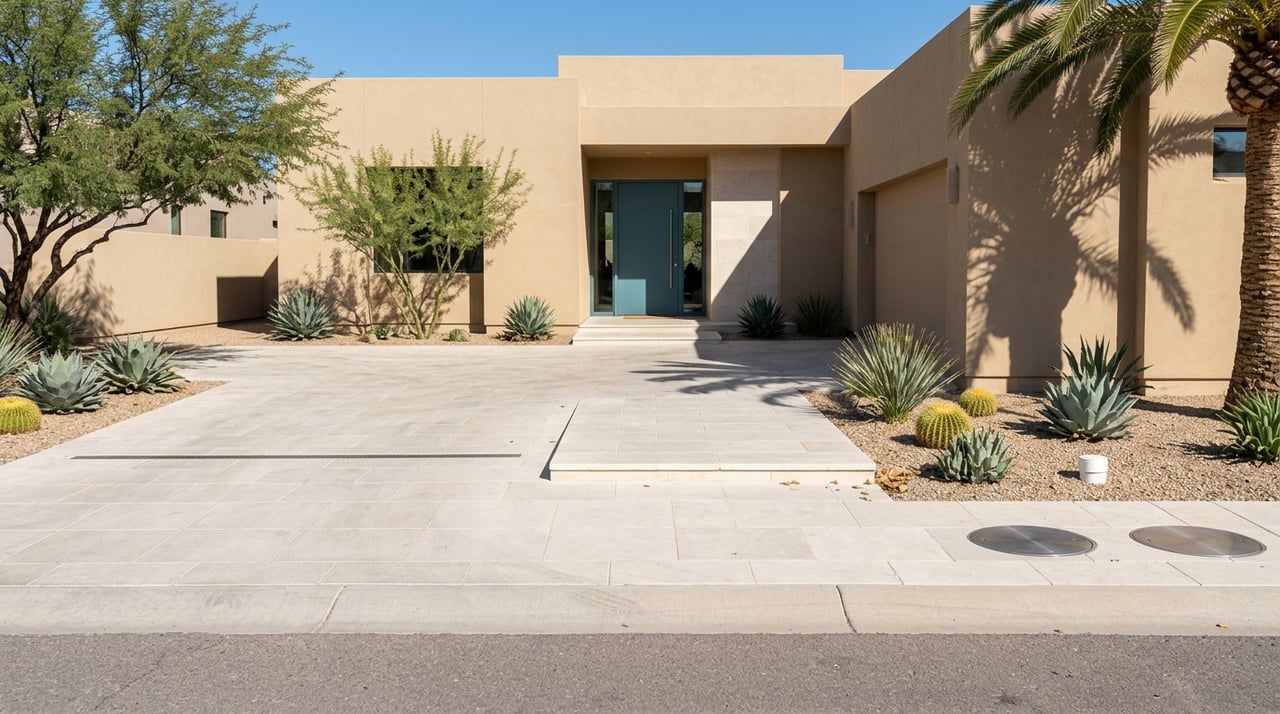
A beautiful Paradise Valley lot can be the wrong lot in disguise. If you are planning a custom home or evaluating a teardown, the real question is not just how big the parcel looks or how strong the views feel. It is whether the site can actually support the home you want to build without costly redesign, permit friction, or avoidable delays. This guide will walk you through the lot factors that matter most in Paradise Valley so you can evaluate land like an owner, not just a shopper. Let’s dive in.
Why buildability comes first
In Paradise Valley, lot selection is largely a buildability decision. Zoning district, frontage, lot shape, topography, drainage, utility service, and the permit path all shape what you can realistically build.
That matters because two lots with similar pricing can perform very differently once you study setbacks, height limits, easements, washes, or hillside review. A parcel that seems straightforward at first can become expensive if the site forces major plan changes or zoning relief.
The Town also directs applicants to use pre-application review before most zoning relief, lot splits, and right-of-way or easement changes. If a property may require any of those steps, that should factor into your timeline and negotiation strategy early.
Check zoning before design ideas
Zoning sets the development envelope
In Paradise Valley, the zoning district affects more than minimum lot area. It also shapes width requirements, floor area constraints, and height expectations.
For example, the Town’s residential zoning table shows that R-175 requires 175,000 square feet and 165 feet of width. R-43 requires 43,560 square feet and 165 feet of width, and that district also carries a 25% FAR and a two-story limit. If you are comparing lots by price per acre alone, you can miss a major difference in what each site can actually support.
Lot shape matters too
A lot can meet the area requirement and still create planning challenges. Paradise Valley’s subdivision code requires a configuration test in which the lot lines and front setback must enclose a circle at least as wide as the district’s minimum lot width.
In simple terms, awkward geometry can limit usable building area even when the parcel looks large on paper. This is one reason a survey and a detailed site review are so important before you finalize an offer.
Frontage can change how a lot functions
Front yard designation is not always obvious, especially on corner lots, double-frontage lots, or curved streets. The Town may consider the public-entry door, recorded plat, nearby property patterns, and the lower-classified street when deciding primary frontage.
That affects setbacks, orientation, and how your design team positions the house, driveway, and entry sequence. On a custom-home site, frontage is not just a label. It directly influences the layout.
Evaluate edge conditions early
Corridor lots need extra design attention
Lots on Lincoln Drive or Tatum Boulevard sit along visually significant corridors identified by the Town. That does not create a private view protection right, but it does mean streetscape treatment, screening, and landscape design carry more weight along those frontages.
If you are drawn to one of these locations, treat the street-facing experience as part of the project from day one. Privacy strategy, wall placement, and landscape planning may need to work harder there than on a more interior parcel.
Corner lots can lose usable privacy
Corner parcels often feel larger and more open, but they come with tradeoffs. Paradise Valley generally limits fences, walls, hedges, and other obstructions to 2 feet high within 50 feet of street intersections, subject to limited tree exceptions.
That can reduce privacy and limit how much visual screening you can create near the street edge. If your wish list includes gated courtyards, layered landscaping, or a strong sense of enclosure, a corner lot deserves closer scrutiny.
View fencing is part of the plan
In Paradise Valley, view fencing is a regulated design element. Flatland submittals require the open percentage of a view fence to be shown, and 70% openness is the minimum. In the hillside code, view fencing is defined as 80% open.
If your lot value depends on preserving mountain or city views, fence lines and retaining walls should be considered early. Waiting until late in design can create conflicts between privacy, grading, and view preservation.
Hillside status can change everything
A mild slope may trigger hillside review
One of the biggest hidden variables in Paradise Valley is hillside status. The hillside regulations apply not only to land in the mapped hillside area, but also to sites where the natural terrain under the building pad slopes 10% or more, with narrow wash-related exceptions.
That means a lot that does not appear dramatically steep can still fall under hillside rules. If that happens, the review process and design expectations change in meaningful ways.
Hillside projects face added review
Once a parcel is treated as hillside, the Hillside Building Committee reviews items such as land disturbance, height, lighting, materials, grading, and drainage. The code also requires a pre-application for hillside development and may involve both concept and formal review meetings.
The Town expects the architect and engineer to be part of the concept review. It also states that clearing, grubbing, grading, or earth movement should not begin before approvals and permits are issued.
Flatland lots still have strict limits
Even if a parcel is not hillside, Paradise Valley still regulates massing carefully. On flatland parcels, the Town uses open-space criteria tied to a roof-envelope concept and 20-foot setback control points.
Height limits also vary by lot size. Primary residences are limited to 24 feet under 3 acres, 26 feet from 3 to under 4 acres, and 30 feet for 4 acres or more. Accessory structures are limited to 16 feet, including the chimney.
Teardown lots need more than vision
Demolition has its own permit path
A teardown is not automatically a faster path to a new custom home. In Paradise Valley, a demolition permit is required when more than 12 linear feet of wall, fence, roof, or slab will be removed, and that demolition permit must be obtained before the building permit is issued.
Depending on the site, the permit package can also involve dust control, stormwater pollution prevention materials, site plans, right-of-way photos, and native-plant documentation. That should be built into your planning and contract timing.
Mature desert landscaping can affect cost
On luxury parcels, native landscaping is often a meaningful asset, but it can also create added site-prep complexity. The Town requires a Native Plant Preservation Plan for building permits valued at $500,000 or more, along with all demolition and grading permits.
Protected plants may not be destroyed, removed, or relocated before approval. If a lot includes mature desert vegetation, you should treat plant preservation and relocation as a real budget and timeline item.
Drainage and washes are not side issues
Historical flow patterns matter
Paradise Valley’s engineering staff reviews grading and drainage for new homes and remodels to preserve historical flows and provide stormwater retention. The Town has also adopted a stormwater master plan to identify flood-prone areas.
For buyers, this means drainage is not a back-end engineering detail. It is a front-end lot selection issue that can affect pad placement, usable yard area, grading costs, and permit review.
Private washes deserve special review
If a parcel includes a wash, study it closely. The Town states that residents must maintain private washes before monsoon season, state law prohibits blocking washes, and fencing over a wash requires a permit and must be installed above the flow line.
That can influence driveway layout, wall location, and overall site planning. A wash can be manageable, but only if you understand its impact before you commit.
Verify utilities before you write the story
Utility service in Paradise Valley is location-specific rather than uniform. The Town notes that water and sewer service vary by location, and many properties still rely on septic.
Engineering review is also required for right-of-way work such as driveway, sidewalk, utility, or drainage improvements. Before you move forward on a lot, confirm utility service and any site-specific improvement requirements as part of due diligence.
A smart Paradise Valley lot checklist
Before you move from interest to offer, focus on the questions that drive real feasibility:
- Confirm the zoning district, frontage type, and whether the parcel is in a hillside development area.
- Order a survey and identify easements, washes, utility boundaries, and any corner-vision constraints.
- Review lot shape, width, and setbacks before assuming your preferred home size will fit.
- Ask whether demolition, grading, native-plant, or right-of-way permits will be needed.
- Verify whether water, sewer, or septic conditions create additional cost or timing.
- Bring your architect, civil engineer, and builder into the discussion as early as possible.
- If the deal involves a lot split, subdivision plat, or variance request, start with the Town’s pre-application process.
Why experienced guidance matters
In Paradise Valley, the difference between a promising lot and a costly mistake often comes down to what you identify before closing. The right site can support clean execution, stronger design outcomes, and a smoother path through review.
That is where practitioner-level guidance matters. When you evaluate lots through the lens of development, construction, and entitlement risk, you make better decisions and protect more of your time and capital.
If you are considering a Paradise Valley lot for a custom home or teardown, Templeton Walker can help you assess the opportunity with a practical, development-minded perspective.
FAQs
What should you review first on a Paradise Valley custom-home lot?
- Start with zoning, frontage, lot shape, hillside status, easements, washes, and utility service, because those factors determine whether the home you want is likely to fit the site.
How does hillside status affect a Paradise Valley build?
- Hillside status can trigger pre-application review and Hillside Building Committee oversight for grading, height, drainage, lighting, materials, and land disturbance, even on sites with natural terrain slopes of 10% or more under the building pad.
Do Paradise Valley teardown properties need separate permits?
- Yes. If more than 12 linear feet of wall, fence, roof, or slab will be removed, a demolition permit is required before the building permit is issued.
Why do washes matter when buying land in Paradise Valley?
- Washes can affect driveway placement, fencing, wall location, yard usability, maintenance obligations, and grading design, and they cannot be blocked.
Are utilities consistent across Paradise Valley lots?
- No. Water and sewer service vary by location, and many properties are still on septic, so utility verification should be part of your due diligence before you finalize an offer.